
Verified West Allis City Directory Collections
The verified shelf is a patchwork, and that is worth knowing up front. Specific West Allis issues survive from the early through the mid-twentieth century. A catalog entry names Wright's 1912-1913 volume. Broader Milwaukee-area runs can also carry suburban listings under regional headings. The West Allis Public Library publishes no complete year-by-year print inventory, so CountyCat and a reference librarian stay essential parts of the search.
| Collection | Years located | Where held or indexed | Access |
|---|---|---|---|
| West Allis City Directory | 1904, 1910, 1912, 1913, 1916, 1918, 1921, 1923, 1925, 1927, 1929, 1932 | U.S. directory indexes and cataloged copies | Licensed image/index or item-level library access |
| Later West Allis issues | 1936, 1938, 1940, 1942, 1945, 1950, 1953, 1957, 1960 | Directory aggregations and catalogs | Verify each title page and image source |
| Wright's directory of West Allis | 1912-1913 | FamilySearch catalog evidence | Catalog, affiliate, or library copy |
| Milwaukee directory run | 1847-present; online 1861-1960 | Milwaukee Public Library Zeidler Room | Print, microfiche, microfilm, and in-library database |
| Bresser cross-index | 1969-2000 | Zeidler Room, call number 910.1 B843 | In person; confirm West Allis coverage |
| Regional telephone books | 1881-1967 film; later print runs vary | Zeidler Room | Staff-assisted shelf and film search |
These dates mark evidence, not a promise. A missing year can reflect a catalog gap, a shelf gap, a publication gap, or access limited by a library license. Never fill a gap by inference.
Start the West Allis Historical Search Locally
West Allis Public Library at 7421 W. National Avenue is the first practical stop. Adult Reference answers at 414-302-8500. Hours run Monday through Thursday, 9:30 a.m. to 8:30 p.m., and Friday and Saturday, 9:30 a.m. to 5:30 p.m. Sunday brings no service. Ask staff to search CountyCat for historical directories, telephone books, local history, yearbooks, obituaries, and the street or neighborhood tied to the person.
Ancestry Library Edition works only inside the building. NewsBank carries the Milwaukee Journal and the Greenfield-West Allis NOW, while Heritage Hub handles obituary and death-notice searching. Most remote databases demand a 14-digit West Allis library card. The reference desk, the phone, CountyCat, and Ask a Librarian all matter, because the website itself is not an exhaustive shelf list.
The Regional West Allis Directory Shelf in Milwaukee
The Frank P. Zeidler Humanities Room at Milwaukee Public Library holds the strongest documented regional collection. Print Milwaukee directories from 1848/49 through 1922 wait at the reference desk. Volumes from 1923 forward sit in the room, with some years missing. Microfiche covers 1847-1860, microfilm covers 1861-1960, and Ancestry Library Edition carries digitized material across those same 1861-1960 years.
Milwaukee-area books may list West Allis as a suburb or a separate section, but that coverage changes edition by edition and must be checked each time. The room also keeps historic Wisconsin city books, reverse-address material from 1921 forward, Bresser volumes, and telephone directories. Call ahead or search the catalog before a visit to confirm the format, the call number, and whether a reader machine or staff retrieval is required.
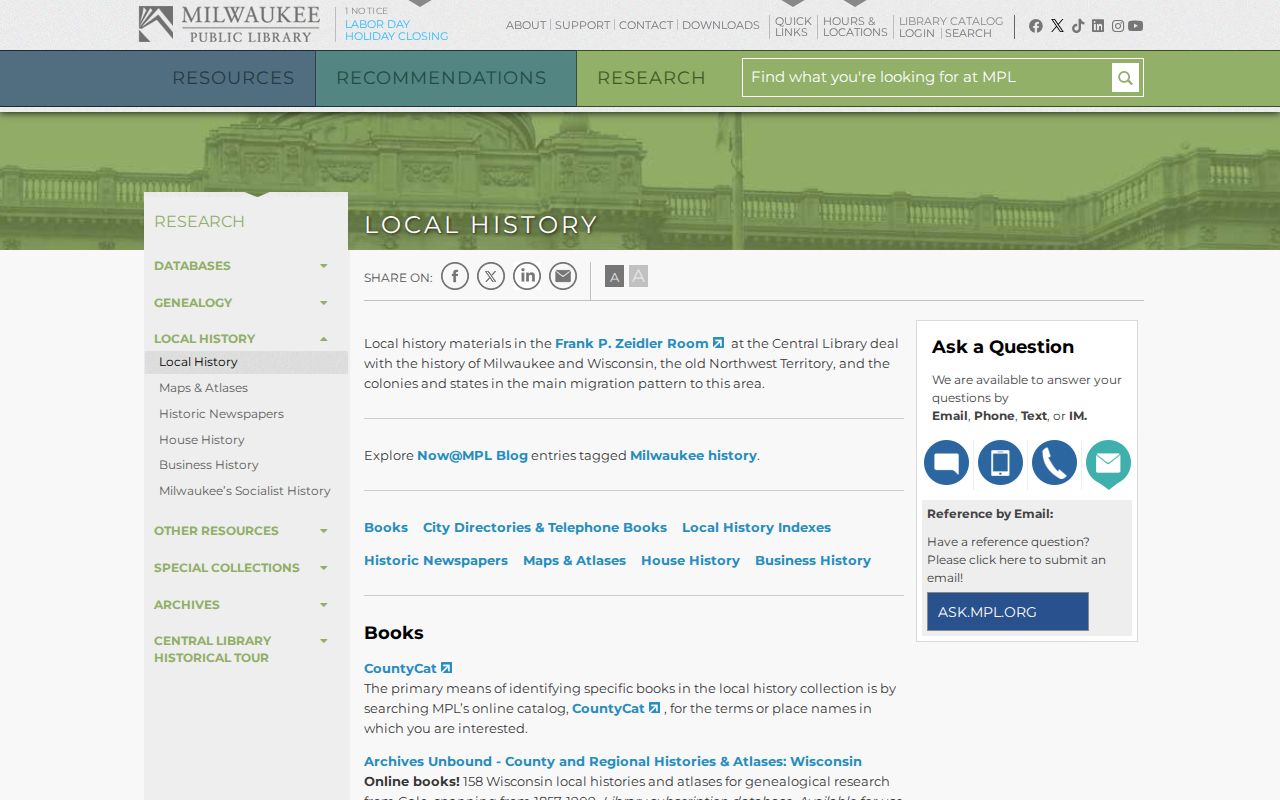
The captured Milwaukee Public Library local-history page outlines these directory formats and access routes.
Decode a West Allis City Directory Entry
Find the abbreviation key in the same volume before expanding any mark. A typical entry can pack a surname and given name, a spouse in parentheses, an occupation, an employer, and a residence onto one line. It may also carry a house or room notation on that same line. Later volumes tend to list wives and roomers more fully than early books did. They also add other non-owner occupants in greater detail. The field inventory below reflects standard directory practice rather than a quoted local entry.
| Name | Surname, given name, initials, and sometimes a spouse in parentheses |
|---|---|
| Occupation | Trade or role, sometimes followed by an associated company |
| Residence | House number and printed street abbreviation |
| House marks | “h,” “r,” or another edition-specific notation that must be checked in the key |
| Phone or business | May appear in later telephone or combined editions |
- Criss-cross directory
- A later address-based section or volume arranged by street and house number rather than surname.
- Householder index
- A name or address tool centered on the person listed for a household, not a complete roster.
- Abbreviation key
- The publisher's own guide to shortened words and symbols in that edition.
Photograph or cite the title page, year, key, entry page, and street section. That habit keeps one publisher's marks from being read with another publisher's meanings.
A West Allis Directory Timeline With Known Gaps
The timeline opens with a verified 1904 issue rather than an assumed first publication date. Wright's named 1912-1913 title anchors one publisher era. Located issues continue at intervals through 1960. Address-order searching appears in Milwaukee regional material from 1921 forward. Bresser adds a cross-index route from 1969 through 2000. No official source names the final printed West Allis year.
| Point in the trail | What is supported |
|---|---|
| 1904 | Earliest West Allis issue located in this research |
| 1912-1913 | Named Wright Directory Company title in catalog evidence |
| 1921 | West Allis issue located; regional reverse-address era documented |
| 1936-1960 | Selected later issues appear in directory aggregations |
| 1969-2000 | Bresser cross-index held regionally, with local inclusion to confirm |
Let the gaps shape questions for librarians. Do not label them war suspensions, lost books, or unpublished years unless an item-level source says so.
Search West Allis Under Its Earlier Place Names
A directory search can fail simply because the place label changed. Honey Creek was in use by 1837. The railroad station went by North Greenfield in 1880. The area was platted under that name in 1887. The village adopted West Allis in 1902, and the city was declared in 1906. Annexations from Greenfield and Wauwatosa widened the municipal footprint during the 1950s.
Search under West Allis, North Greenfield, Honey Creek, and Milwaukee. Also try the right township or a neighboring municipality. Preserve the spelling and abbreviation exactly as printed in the book. A Milwaukee postal label alone does not place an address outside West Allis. Old maps, plats, and ward boundaries can settle geography. The legal description can settle it too, where a catalog keyword cannot.
Trace a West Allis Family Across Directory Years
A directory trail works best in small steps, paired with sources that answer different questions. Start from a known year and identity. Then search on both sides of it. Treat a missing entry as a question, not an event.
- Find the first clear alphabetical entry and copy it exactly with the page citation.
- Move forward and backward through available years, recording addresses and name variants.
- Use the reverse section to inspect the address and nearby entries in the same year.
- Pair the run with the 1950 census or another released federal census when the dates fit.
- Use a deed, obituary, probate file, vital index, or cemetery entry to test the transition.
The federal census opens after 72 years and can reveal household relationships a directory leaves out. Differences between the two do not always signal an error. The book and the census may use different reference dates, and a move, a spelling choice, a roomer, or a skipped canvass may explain the mismatch.
Close a West Allis Directory Trail With Local Sources
NewsBank lets you pair a full name with variant spellings, a street, and a rough decade. That combination works well. When you save a hit, record the publication title, date, and page instead of a bare database result. Historical Society photographs and artifacts then add the neighborhood context a printed line never can. Sanborn and fire-insurance atlases plot building footprints too. Confirm the exact West Allis sheet first, though, before tying a footprint to one lot.
Honey Creek Cemetery gives the trail a local endpoint. It opened with an 1849 one-acre purchase. The Historical Society's free listing spans burials from 1849 through 1974 and draws on original burial records, association minutes, and later transcription work. Treat each entry as a name, date, lot, and family clue. It is not a certified death record.
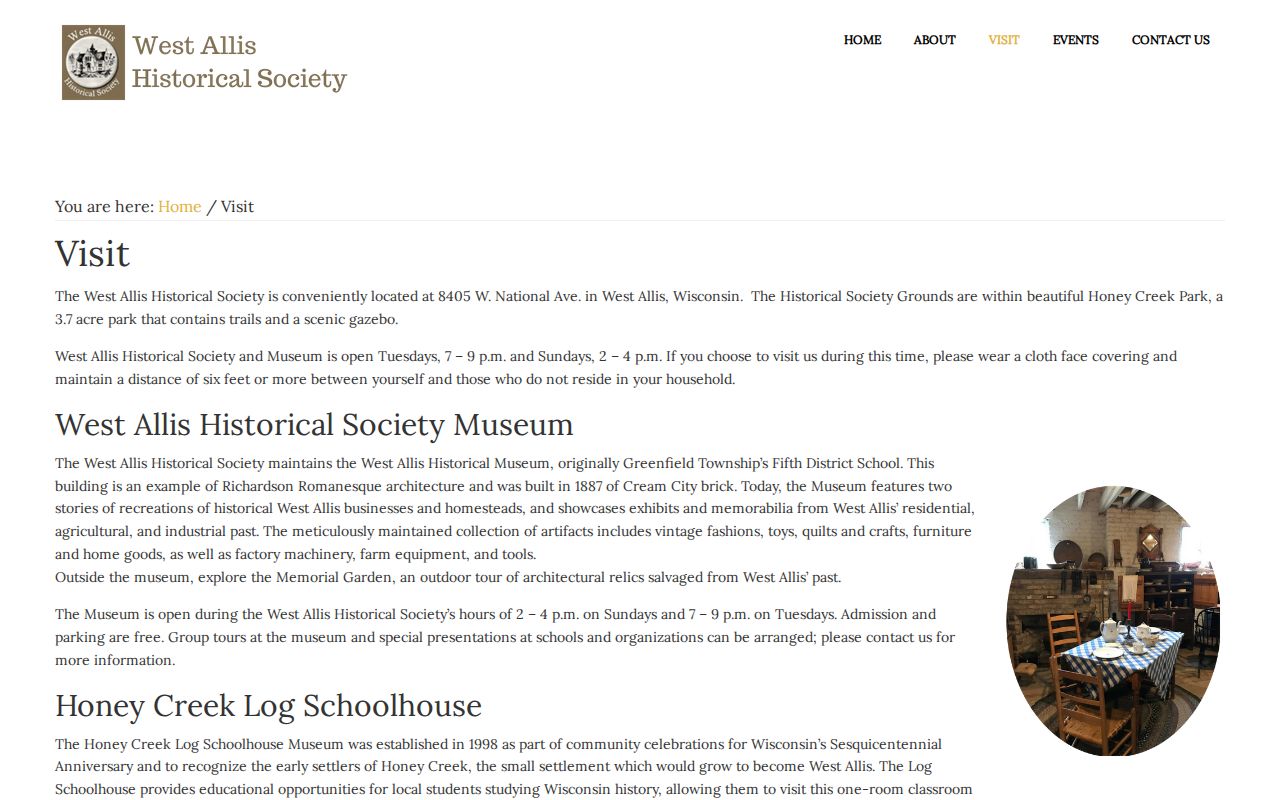
The captured West Allis Historical Society visit page identifies the museum and local collection contact.
What West Allis Directory Listings Do Not Prove
A directory listing only proves one thing. A publisher linked a name with an address, trade, or phone near the volume's date. It is not a certified record. Nor is it a complete household list, an exact move date, or proof of ownership. People got skipped or declined a listing. Some appeared under initials, or lingered in print after circumstances changed.
For ownership, turn to deeds and assessor material. Census, probate, obituary, cemetery, and vital records test family relationships far better. For modern address-keyed questions, follow the West Allis street directory workflow instead of reading an old city directory as a current resident roll. When a search stops at a catalog record, ask library staff about the physical volume, microform, licensed image, or interlibrary route.